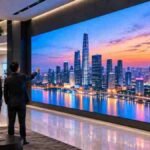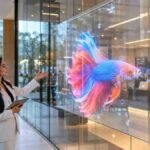
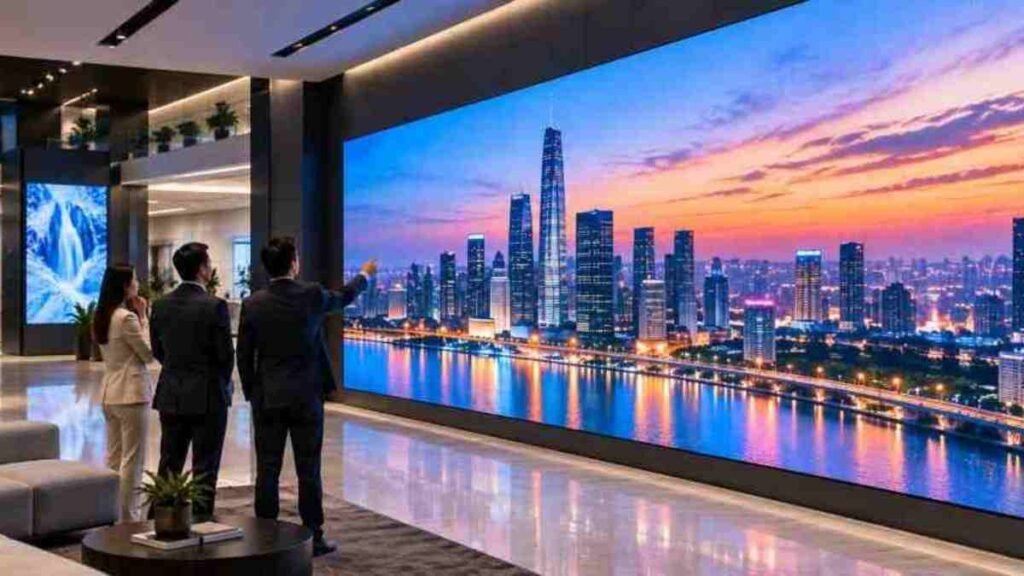
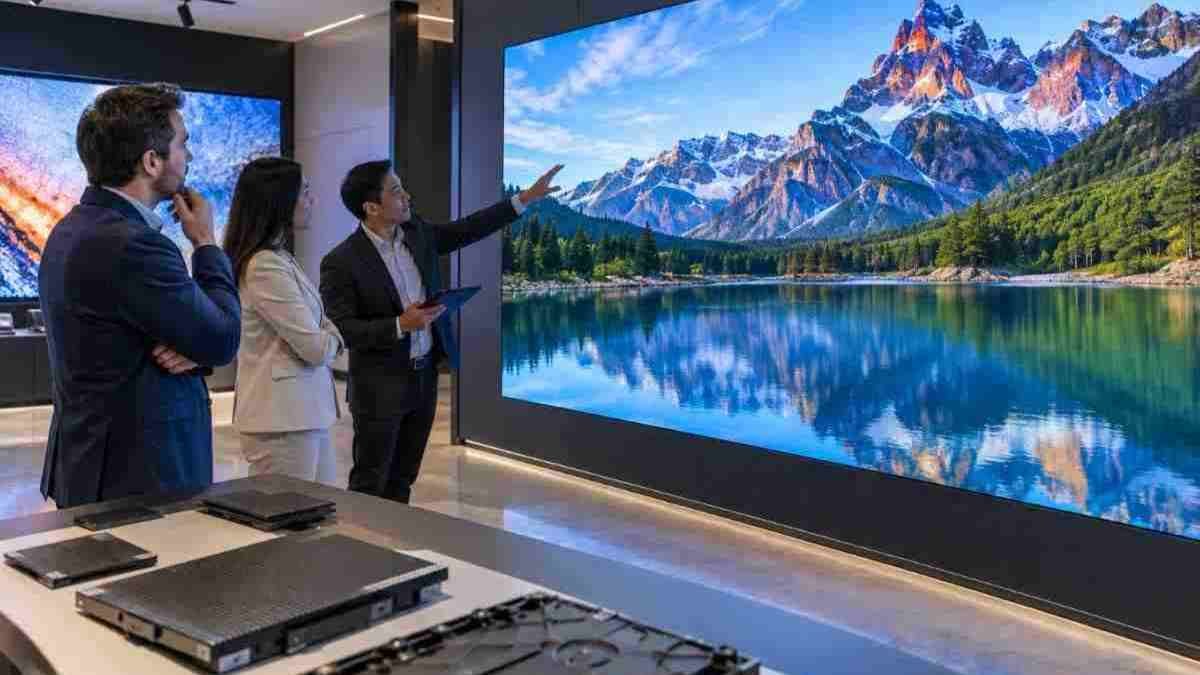
Sit two demo panels side by side in a showroom and both look spectacular. That’s the problem. Almost any modern display looks good at 10 metres with a bright reel playing, and the differences that will annoy you three years from now stay invisible in a 15-minute demonstration. A micro COB LED video wall is a serious capital purchase, usually installed in one of the most visible rooms in a building, so it deserves more rigour than a showroom visit. Glasstronn helps buyers evaluate display requirements around viewing distance, image quality and installation, while Glasstronn solutions can be assessed according to the specific needs of the project.
Here are the questions worth asking before a shortlist gets made: pixel pitch and viewing distance, the specifications that genuinely affect image quality, how the wall behaves when something fails, and where the money actually goes.
What Makes a Micro COB LED Video Wall Different
Conventional fine-pitch panels use SMD packaging, where each tiny red, green and blue package is soldered individually onto the board. Micro COB LED construction takes a different approach: the bare LED dies are mounted directly onto the PCB and then encapsulated under a protective resin layer that covers the module face. Glasstronn’s Micro COB LED technology content also highlights durability, fine pixel pitch and high-resolution visual performance as key characteristics of the technology.
The consequences are practical. There are no exposed lamp packages to knock off during transport or cleaning, which can help protect the display surface during handling. The flat resin face is also easier to clean, which matters in a lobby or other high-traffic environment.
Contrast performance can also benefit from the encapsulated surface because ambient reflections are reduced. At very fine pitches, COB construction becomes particularly relevant for buyers comparing compact pixel configurations and long-term durability.
Pixel Pitch and Viewing Distance Come First
Everything else is secondary to this pair. Pixel pitch is the centre-to-centre distance between pixels, and it influences the closest point at which a viewer can comfortably view the image without individual pixels becoming distracting.
| Pixel Pitch | Comfortable Viewing From | Typical Use |
| P0.6 to P0.9 | Under 1.5 m | Control rooms, studio walls, executive briefing rooms |
| P1.0 to P1.2 | 1.5 to 2.5 m | Boardrooms, lobbies, premium retail |
| P1.5 to P1.8 | 2.5 to 4 m | Auditoriums, larger meeting spaces |
| P2.0 and above | 4 m and beyond | Halls, atriums, back walls |
A rough planning rule is that pixel pitch in millimetres can be compared with viewing distance in metres when estimating the minimum practical viewing distance. However, the actual choice should also consider content type, resolution, room geometry and viewer expectations.
Buying a tighter pitch than the room requires is one of the easiest ways to increase the display budget without creating a noticeable benefit. If the nearest seat is four metres away, a P0.7 wall may not provide meaningful additional value compared with a slightly larger pitch.
Resolution, Cabinet Sizes and the 4K Question
Pixel pitch alone does not determine resolution; physical wall size does.
A 3840-pixel-wide image at P1.2 requires a wall roughly 4.6 metres across. At P0.9, the same 4K pixel width fits into approximately 3.45 metres. Work backwards from the wall you actually have, and be honest about whether the content will consistently be true 4K.
Cabinet dimensions matter more than buyers expect. Standard 600 × 337.5 mm modules can scale neatly into 16:9 walls, while 500 × 500 mm cabinets can suit unusual aspect ratios but may not produce a clean 16:9 overall configuration.
Confirm the cabinet grid of your micro COB LED video wall against the architectural opening before ordering. A wall that misses the recess by even a small amount can become a carpentry or mounting problem on site.
Image Quality Specs That Actually Matter
Brightness, Contrast and Colour
Indoor walls rarely need maximum brightness. Many installations operate within a moderate brightness range, depending on room lighting, viewing conditions and display specifications.
What matters is stable performance at the brightness level the room will actually use. Ask to see the wall at lower brightness settings because inexpensive drivers or poorly calibrated systems can show banding and colour shifts in dark greys.
A showroom demonstration at maximum brightness does not tell you how the wall will perform during a normal boardroom presentation or corporate video.
Refresh Rate, Grayscale and Bit Depth
If a camera will ever point at the display, refresh rate becomes an important specification. Lower refresh rates can create scan lines or flickering effects on camera.
Broadcast environments, hybrid meeting rooms and recording studios should therefore examine refresh-rate specifications alongside grayscale performance and colour consistency.
Grayscale performance at low brightness is another quiet differentiator. Two walls with the same pixel pitch can look noticeably different when displaying dark cinematic content, presentations or subtle gradients.
How a COB LED Display Behaves When Something Fails
A COB LED display is designed around an encapsulated LED structure, but no display system is completely immune to component failure.
Ask three questions of every vendor:
1. Is Service From the Front or the Rear?
Front service is particularly important if the wall sits against a structural wall or another location where rear access is difficult.
2. What Is the Smallest Replaceable Unit?
A module-level replacement can be simpler than replacing an entire cabinet. Confirm exactly what the supplier considers a replaceable unit and how much time a typical replacement requires.
3. Can Replacement Modules Be Colour-Matched Later?
Ask whether modules can be matched to an ageing wall several years after installation and how long compatible production batches or spare stock will be maintained.
One consideration specific to Micro COB LED panels is that individual pixel repair is generally not the normal field-service approach. The affected module is typically replaced rather than repairing a single encapsulated pixel.
That makes spare stock important. Budgeting for a small set of original-production spares can help maintain colour consistency if a module needs to be replaced later.
Power, Processing and Room Requirements
Power and Heat for a High Resolution LED Wall
A high resolution LED wall of any significant size draws real power. Plan for the peak requirement rather than relying only on average consumption, and confirm whether the supplier specifies redundant power supplies or feeds for critical installations.
Heat is the companion consideration. A large display in a sealed meeting room can contribute to the room’s cooling load, so the power and thermal requirements should be discussed with the MEP consultant early in the project.
Processors, Sources and Control
A complete display specification should consider:
- Video processor with enough inputs for present and future sources
- Redundant receiving cards or backup processing for critical installations
- Content scaling that suits the actual aspect ratio
- A simple control interface for everyday users
- Commissioning and calibration included in writing
- Clear documentation for maintenance and future service
The display should be designed around how the room will actually be used rather than simply around the maximum specifications available from the manufacturer.
What a Micro COB LED Video Wall Costs
Pricing is driven mainly by pixel pitch, and the curve can become steep as the pitch becomes finer. Moving from P1.2 to P0.7, for example, can substantially increase the per-square-metre cost.
Cabinet construction, processor selection, mounting structure, power requirements, spare modules and commissioning make up the rest of a premium video wall budget.
Treat any headline rate as indicative until the site is surveyed. Structure, access, electrical work and installation conditions can move the final project cost significantly.
What to Check in the Warranty
Do not look only at the number of warranty years. Ask what is covered on:
- LED modules
- Power supplies
- Receiving cards
- Control systems
- Processing equipment
- Installation workmanship
Also ask how long spare stock will be maintained and what the expected response time is for a service call in your city.
A longer warranty is not necessarily useful if replacement components, technical support or service engineers are difficult to access. The complete after-sales arrangement should be evaluated alongside the display specification.
Why Choose Glasstronn for Micro COB LED Video Walls?
Selecting a Micro COB LED system involves more than choosing the smallest pixel pitch. Viewing distance, room lighting, cabinet configuration, processing, service access, power requirements and future maintenance all influence the final result.
Glasstronn provides LED display solutions and related visual-technology systems for modern commercial environments. Its published Micro COB LED material focuses on applications requiring fine pixel pitch, durability and high-resolution visual performance.
For boardrooms, control rooms, corporate interiors, retail spaces and other premium environments, evaluating the complete installation rather than comparing one specification at a time can help buyers create a more practical shortlist.
Frequently Asked Questions
Is a micro COB LED video wall better than an SMD fine-pitch wall?
The appropriate technology depends on the pitch, viewing distance, environment, budget and service requirements. COB construction can provide a protected encapsulated surface and is particularly relevant to fine-pitch applications. For larger pitches, a good SMD solution may remain competitive. The technology should therefore be matched to the actual room rather than selected purely because it is newer.
How long does this kind of display last?
Manufacturers commonly specify operating-hour figures based on brightness degradation, but actual service life depends on operating conditions, brightness, thermal management, maintenance and component quality. A properly specified and maintained Micro COB LED video wall can provide many years of service.
Can individual pixels be repaired?
Usually, servicing involves replacing the affected module rather than repairing an individual encapsulated pixel. This is why maintaining compatible spare modules from the original production batch can be useful for future service.
What pixel pitch suits a normal boardroom?
For a room where the closest viewer sits around two to three metres away, P1.2 to P1.5 can be a practical starting range. The final selection should be confirmed using the actual seating distance, content type and a demonstration viewed from the intended position.
Conclusion
The temptation with any premium video wall is to compare headline numbers and pick the tightest pitch the budget allows. A better approach is to balance the specification: match pixel pitch to the nearest viewer, match refresh rate to whether cameras will be used, set brightness according to the room rather than the maximum capability, and establish a service arrangement that works when a module needs replacement.
A micro COB LED video wall selected on those criteria can deliver a consistent visual experience while keeping installation and maintenance requirements in view. Before placing an order, review the cabinet configuration, viewing distance, content resolution, processing, power requirements, service access and spare-module strategy together.
If you are comparing displays for a specific room, arranging a demonstration at your actual viewing distance with your own content is one of the most useful steps you can take.
Ready to Compare Your LED Video Wall Options?
Planning a Micro COB LED installation for a boardroom, control room, retail space or corporate environment? Share your room dimensions, viewing distance and display requirements with Glasstronn to discuss a suitable configuration. Schedule a Micro COB LED Consultation
Follow Glasstronn on Instagram for LED display projects, smart technology updates and visual-display solutions.