A ground-floor bedroom facing a shared driveway is one of the more awkward briefs in residential design. You want the daylight and the view, but after dark the room becomes a lit display case, and the usual fix is a curtain drawn eleven months of the year. Privacy glass windows answer that differently. The glass itself changes state.
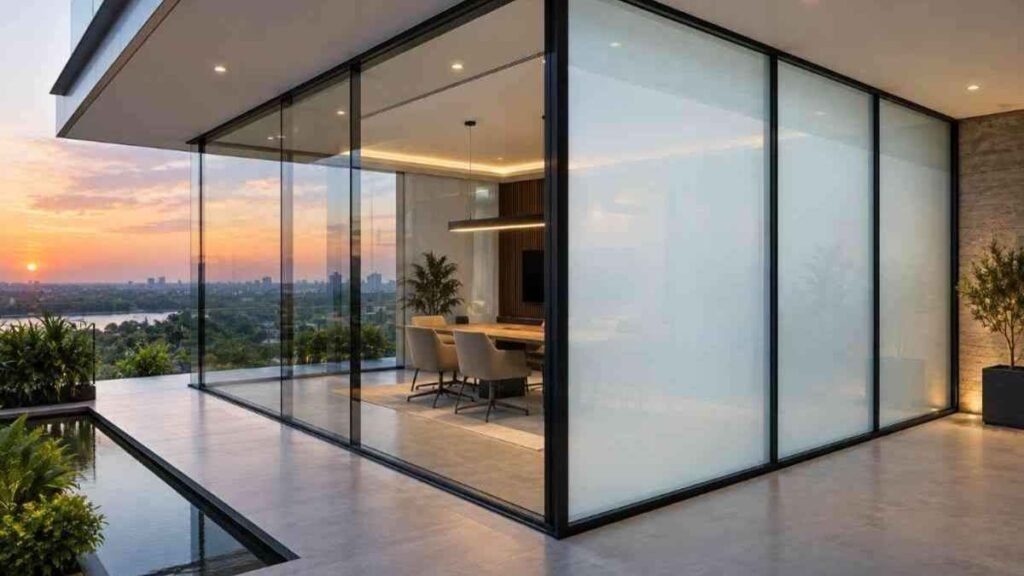
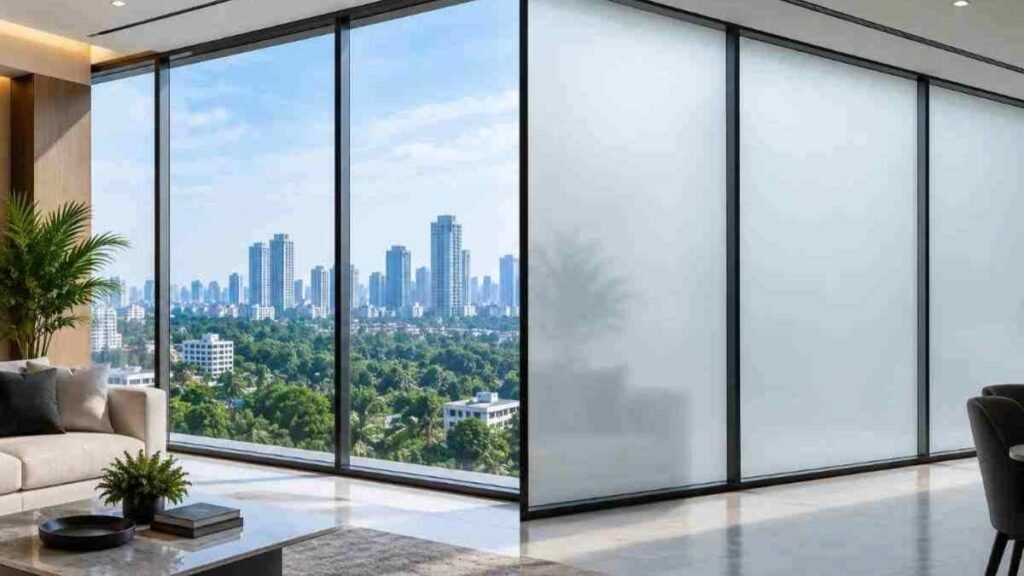
Switch it on and the pane is clear. Switch it off and it turns a milky white that blocks sightlines while daylight still comes through. No fabric, no dust trap, no blind mechanism to service every monsoon. Glasstronn smart glass solutions provide a way to manage privacy without relying on conventional window coverings. For residential and commercial applications, Glasstronn helps project teams consider the appropriate glass configuration, controls and installation requirements. The technology isn’t new, but the right specification is important when planning a switchable window system.
What Privacy Glass Windows Actually Are
Strip a panel down and you’ll find a polymer dispersed liquid crystal film between two transparent conductive layers, laminated inside glass with EVA or PVB interlayers. With no voltage across it, the droplets sit at random angles and scatter light, so the pane reads as translucent white. Feed it low-voltage AC through a driver, the droplets line up, and the pane clears in under a second. That behaviour is the whole proposition behind privacy glass windows. Nothing moves in the sightline, nothing jams, nothing needs dusting.
The layer doing the work
Busbars run along one edge of the film and carry current across the conductive coating, so that edge has to sit inside the frame or beading. Two site realities follow. The private state is translucent, not black, so a bedroom facing a streetlight still glows softly; genuine darkness needs blackout switchable film, a different product configuration. And sizes must be locked before cutting, because a panel trimmed on site can be damaged and become unusable.
Laminated units versus retrofit film
- Factory-laminated PDLC window glass: film sealed inside the glass sandwich, edges protected. Best for external glazing and humid coastal sites. Longer lead time, and damage means replacing the whole unit. Most projects laminate the external envelope and retrofit internal partitions.
- Retrofit film on existing glazing: applied to the inner face of glass already installed. Faster and cheaper, and the sensible route for an occupied office. Edges are silicone-sealed rather than laminated, so it’s less forgiving where condensation collects.
How Smart Glass Windows Change the Window Line
A blind box eats 150mm to 250mm of ceiling depth, plus a pelmet and a service gap you can never quite reach. Take that away and the detail simplifies: slimmer reveals, cleaner soffits, full-height glazing uninterrupted by a track. Smart glass windows also handle geometry that blinds cope with badly, like double-height stairwell glazing or a curved bay.
One trade-off deserves stating plainly. Privacy glass windows draw a small current in the clear state, a few watts per square metre, and they fail to the private state when supply drops. In a bedroom that’s a useful privacy feature. In a shopfront, an outage that whites out your display during business hours is a real annoyance, so retail projects usually put the circuit on backup.
Where Switchable Glass Windows Earn Their Keep
The strongest cases share one trait: the same pane needs to be clear at some hours and private at others.
- Ground-floor bedrooms and bathrooms overlooking a compound wall or a neighbour’s balcony.
- Street-facing apartments in dense blocks where setbacks are minimal and curtains stay shut permanently.
- Hospital rooms and consultation bays, where privacy is needed in seconds and fabric is a hygiene headache.
- Boardrooms with external glazing that double as presentation rooms.
- Retail frontages closing off a bay while a display is changed.
- Hotel suites where the bathroom shares glazing with the bedroom.
Switchable glass windows make far less sense on a toilet vent, a stairwell nobody looks out of, or a budget home where acid-etched glass does the job for a fraction of the cost.
Power, Wiring and Control: The Part Projects Underestimate
Drivers, circuits and cable runs
Each panel runs on AC, commonly 48V to 65V, from a driver that steps down mains supply. One driver covers a limited area, so a wide window wall needs several, in a ventilated and accessible spot: a false ceiling with a proper hatch, not a chased wall that gets plastered over. Coordinate the electrical first fix before glazing arrives, because chasing a cable route in after the frames are set is the commonest source of overrun on privacy glass windows.
Switching options
- Retractive wall switch, the simplest and most reliable choice
- Touch panel or RF remote where a room has several zones
- Occupancy or door-contact sensors, common in hospital and washroom use
- Dimming drivers, where supported by the selected system, can provide an intermediate state rather than only two states
Reading the Spec Sheet: VLT and Product Performance
Quotes look alike until you compare the numbers underneath. Ask for tested figures on the complete unit, not the bare film.
| What to check | Clear State | Private State | Why It Matters |
| Visible light transmission | roughly 70–80% | Product-specific | Indicates how much visible light passes through the complete unit |
| Switching time | Under 1 second | Under 1 second | Shows how quickly the glass changes between states |
| Operating voltage | 48–65 V AC | 48–65 V AC | Must match the supplied driver |
| Acoustic rating | Depends on laminate build | Same | Ask for the Rw of the complete unit |
The exact optical performance depends on the selected product, glass construction and project specification, so request the applicable technical datasheet before ordering.
Yellowing is the failure mode to interrogate. On a west-facing elevation taking hard afternoon sun, a poorly protected film can shift colour over time. Laminated privacy glass windows with a suitable UV-blocking interlayer can be more appropriate for exposed facades than basic retrofit stock, so the installation environment should be considered before choosing a configuration.
What Privacy Glass Windows Cost in India
Pricing moves with glass build, panel size and control complexity, so treat any figure as indicative. Retrofit film, supplied and applied, generally lands around ₹700 to ₹1,400 per sq ft. Laminated smart privacy windows usually start near ₹1,600 per sq ft and can climb past ₹3,000 for toughened, double-glazed or low-E builds. Drivers and switches are priced per circuit and mount up on a multi-zone job.
Two traps catch buyers out. Small orders carry disproportionate setup cost, so one bathroom pane always looks expensive per square foot. And panels wider than standard film widths need seams, which can be visible in the private state. Ask to see a seamed sample before committing to privacy glass windows at scale.
Installation, Site Prep and Warranty
Retrofit work needs a clean, dry room and glass scraped free of old residue. Humidity affects curing, so a monsoon-week application on an open site rarely ends well.
On warranty, confirm the applicable 1–2 year warranty before ordering and establish what is covered. Film, glass, driver and installation may involve different components, so ask for the warranty terms and service responsibility in writing. It is also useful to confirm cleaning requirements and keep any relevant driver documentation for future maintenance.
Why Choose Glasstronn for Privacy Glass Windows?
Choosing privacy glass windows is not only about switching from clear to opaque. The right solution depends on the glass configuration, panel size, installation method, driver requirements, control system and environment in which the window will operate.
Glasstronn provides switchable glass and film solutions for residential, commercial, healthcare, hospitality and other privacy-focused applications. Project requirements can be assessed according to whether the application calls for laminated switchable glass or a retrofit film solution, helping teams plan the product and installation approach before work begins.
For architects, homeowners, interior designers and commercial project teams, reviewing these factors early can help avoid unsuitable specifications and installation complications.
Frequently Asked Questions
Do privacy glass windows still work during a power cut?
They stay private. Without voltage, the liquid crystals scatter light and the privacy glass windows default to the translucent state, so privacy is maintained during an outage. You do lose the clear view until supply returns. For shopfronts or receptions where clarity matters commercially, consider backup power for the circuit.
Can I install privacy window glass on windows I already have?
Usually, yes. Retrofit PDLC film can be applied to the interior face of suitable existing glazing, avoiding frame replacement. The glass must be flat, sound and reachable from inside. This approach suits occupied offices and finished homes, while weather-exposed applications may be better suited to laminated construction.
How private is the frosted state, really?
Very private for sightlines, less so for silhouettes. Faces, screens and documents are generally obscured, but someone standing against a strongly backlit pane can still register as a soft shape. Fine for bedrooms and consultation rooms; in changing areas, consider a solid panel at low level where additional privacy is required.
Do smart privacy windows reduce heat and glare?
Partly. In the private state, the film scatters incoming light, which can reduce glare noticeably and may affect solar gain. It is not a substitute for dedicated solar-control glazing. If heat is the main complaint, consider combining smart privacy glazing with an appropriate low-E or solar-control build rather than expecting the switching layer to provide the complete thermal strategy.
What should I check before ordering PDLC window glass?
Check the required privacy level, glass dimensions, clear-state performance, switching time, electrical requirements, driver location, control method, installation conditions, warranty and maintenance requirements. Also confirm whether a laminated or retrofit construction is more appropriate for the window’s location.
Conclusion
Switchable glazing has moved past the showroom stage. It solves ordinary problems now: the bedroom facing a driveway, the boardroom that must disappear for ten minutes, the clinic room where a curtain is a hygiene liability. Privacy glass windows won’t suit every opening, and there’s no sense paying for instant clarity on a pane you’ll always keep private. Where the requirement genuinely changes through the day, the detailing can make the investment worthwhile.
Settle the electrical route, panel sizes and warranty scope before anything is cut. Glasstronn can help you evaluate the appropriate switchable glass or film configuration for your window requirements. Discussing the project early with Glasstronn can also help clarify installation, control and product considerations before you place an order.
Ready to Plan Your Privacy Glass Windows?
Share your window dimensions and project requirements with our team to discuss the right switchable solution. Request a Privacy Glass Consultation
Follow Glasstronn on Instagram for smart glass projects, switchable privacy applications, technology updates and practical insights.