LED display technology has transformed the way businesses communicate, advertise, and engage with their audiences. From retail stores and corporate offices to control rooms and entertainment venues, LED displays have become an essential part of modern visual communication.
As the demand for high-performance display solutions continues to grow, businesses are often faced with an important question: Should they choose COB LED or SMD LED technology?
Both technologies offer unique advantages and are widely used in commercial display applications. However, understanding the differences between them is essential for making the right investment.
At Glasstronn, we frequently help businesses evaluate display technologies based on their specific requirements. Whether the goal is superior image quality, durability, energy efficiency, or long-term value, selecting the right LED solution can significantly impact performance. Glasstronn believes that informed decisions lead to better display experiences and greater business outcomes.
In this guide, we will compare COB LED and SMD LED technologies, explore their features, advantages, limitations, and help determine which option may be better for different applications.
Understanding LED Display Technology
Before comparing COB and SMD LEDs, it is important to understand the basics of LED displays.
LED displays use light-emitting diodes to create images, videos, and digital content. These displays are known for their brightness, energy efficiency, long lifespan, and ability to deliver vibrant visuals.
Over time, LED technology has evolved, leading to different manufacturing approaches such as SMD and COB. Each method influences display performance, maintenance requirements, and viewing experience.
What Is SMD LED Technology?
SMD stands for Surface Mounted Device.
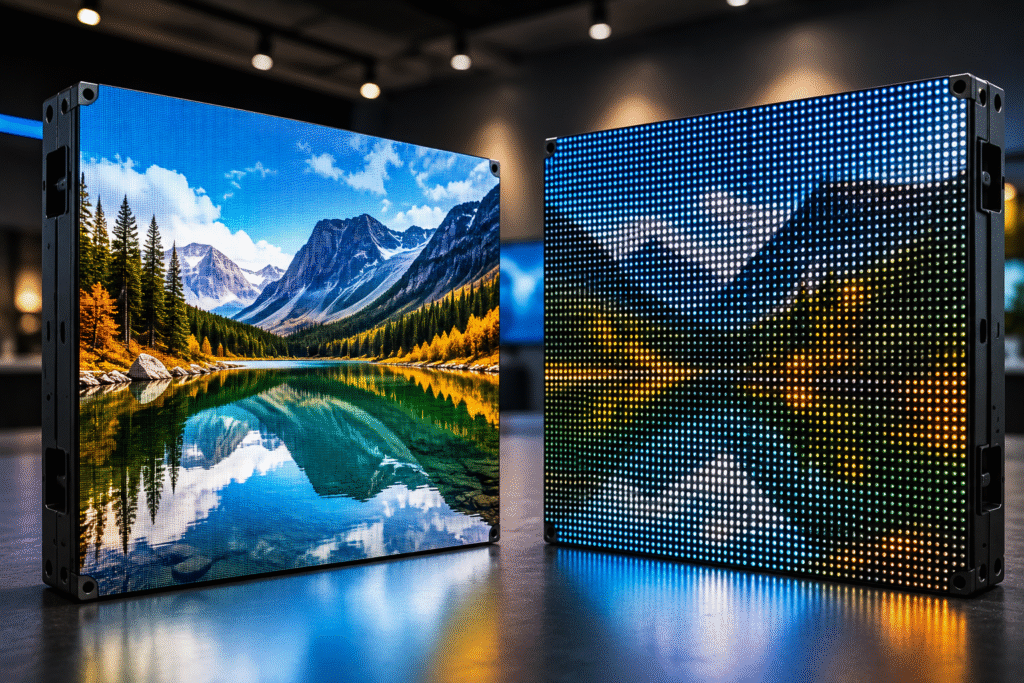
In SMD displays, red, green, and blue LED chips are individually packaged and mounted onto a circuit board. These tiny LEDs work together to create the images and colors displayed on the screen.
SMD technology has been widely adopted across the LED display industry due to its versatility and proven performance.
Key Features of SMD LED
- Excellent color reproduction
- High brightness levels
- Suitable for indoor and outdoor applications
- Widely available in different pixel pitches
- Established technology with broad industry adoption
- Cost-effective for many commercial projects
SMD displays are commonly used in advertising screens, retail displays, event venues, corporate environments, and digital signage systems.
What Is COB LED Technology?
COB stands for Chip-on-Board.
Instead of using individually packaged LEDs, COB technology combines multiple chips on the same circuit board to improve performance and reliability. The chips are then covered with a protective layer that creates a smooth and durable display surface.
This manufacturing method offers several advantages, particularly in applications where image quality and durability are important.
Key Features of COB LED
- Enhanced protection for LED chips
- Improved durability
- Better heat dissipation
- Higher contrast levels
- Reduced glare
- Smooth display surface
- Superior viewing comfort
COB technology is increasingly being used in premium display environments such as control rooms, boardrooms, monitoring centers, and high-end commercial installations.
COB LED vs SMD LED: Major Differences
1. Display Quality
One of the biggest differences between COB and SMD technology is image quality.
SMD displays provide excellent color performance and brightness. They have been the industry standard for many years and continue to deliver strong visual results.
However, COB displays often offer higher contrast and improved image consistency. The protective surface helps create deeper blacks and a more uniform viewing experience.
For businesses prioritizing premium image quality, COB technology often provides an advantage.
2. Durability
Durability is a major factor when selecting a commercial display.
SMD LEDs have exposed components that may be more vulnerable to physical damage.
COB displays feature an additional protective layer that shields the LED chips from dust, moisture, and accidental contact.
This enhanced protection can contribute to longer-term reliability in demanding environments.
3. Heat Management
Heat management directly affects display performance and lifespan.
COB technology generally offers better heat dissipation because the LED chips are mounted directly onto the board.
Efficient heat management helps maintain stable performance and can reduce the risk of overheating.
4. Viewing Experience
Both technologies provide excellent viewing experiences, but COB displays often deliver smoother visuals and reduced glare.
The seamless protective coating can improve comfort during extended viewing periods, especially in control rooms and monitoring environments where displays operate continuously.
5. Maintenance Requirements
Maintenance costs are an important consideration for businesses.
SMD displays may require more careful handling due to exposed LED components.
COB displays are generally easier to maintain because of their durable surface protection.
This can help reduce maintenance expenses over time.
6. Pixel Pitch Performance
Pixel pitch refers to the distance between individual pixels on a display.
Smaller pixel pitches provide higher image resolution and improved close-range viewing.
Both COB and SMD technologies support fine pixel pitches, but COB technology is becoming increasingly popular for ultra-fine pixel pitch applications where image precision is critical.
Advantages of SMD LED Technology
SMD displays continue to be a popular choice for many businesses due to several benefits.
Proven Technology
SMD has been widely used across industries for many years and offers reliable performance.
Cost Efficiency
For many projects, SMD displays can provide a cost-effective solution while delivering strong visual performance.
Versatile Applications
SMD displays are available in a wide range of configurations suitable for indoor and outdoor environments.
Strong Brightness
They provide excellent brightness levels that work well across diverse commercial applications.
Advantages of COB LED Technology
COB technology is gaining popularity because of its advanced features.
Better Durability
The protective layer helps prevent damage from accidental contact and environmental factors.
Enhanced Image Quality
Higher contrast and improved uniformity contribute to a premium viewing experience.
Lower Maintenance
Durable construction often results in reduced maintenance requirements.
Improved Heat Dissipation
Efficient thermal management supports long-term performance and reliability.
Common Applications of SMD LED Displays
SMD displays are commonly used in:
- Retail advertising displays
- Outdoor billboards
- Shopping malls
- Corporate offices
- Event venues
- Sports facilities
- Public information displays
Their versatility makes them suitable for a wide variety of commercial environments.
Common Applications of COB LED Displays
COB displays are increasingly used in:
- Control rooms
- Command centers
- Corporate boardrooms
- Broadcast studios
- Monitoring facilities
- Premium digital signage
- High-end commercial spaces
These environments benefit from the enhanced image quality and durability that COB technology offers.
Which Technology Is Better for Indoor Displays?
Many businesses researching display solutions often ask, what is an indoor led video wall?
An indoor LED video wall is a large display system made up of multiple LED panels that work together to create a seamless visual experience. These installations are commonly used in corporate offices, conference centers, control rooms, and retail environments.
For indoor applications requiring premium image quality and close viewing distances, COB technology is becoming increasingly attractive. However, SMD displays continue to perform exceptionally well in many indoor commercial settings.
The ideal choice depends on project goals, budget, and viewing requirements.
The Role of Mini LED Technology
The LED industry continues to evolve with newer innovations.
Businesses researching advanced display solutions often explore topics such as how mini led displays improve visual quality. Mini LED technology uses significantly smaller LEDs to create improved contrast, brightness control, and enhanced visual performance.
While Mini LED represents a different category from COB and SMD displays, it demonstrates the industry’s ongoing focus on delivering better viewing experiences.
Factors to Consider Before Choosing
Before selecting a display technology, businesses should evaluate:
Budget
Determine the available investment and expected return.
Viewing Distance
Consider how close viewers will be to the display.
Environment
Assess whether the display will be installed indoors or outdoors.
Maintenance Expectations
Evaluate long-term service and maintenance requirements.
Performance Goals
Identify whether image quality, durability, brightness, or operational efficiency is the highest priority.
Industry Trends
Display technology continues to advance rapidly.
Organizations are investing in:
- Higher-resolution displays
- Interactive digital experiences
- Seamless video walls
- Energy-efficient solutions
- Smart display integration
- Advanced visualization technologies
As demand grows for premium visual experiences, COB technology is expected to gain wider adoption alongside established SMD solutions.
Which Technology Should You Choose?
The right choice depends on the specific needs and goals of your project.
SMD LED remains an excellent option for many commercial applications due to its affordability, versatility, and proven performance.
COB LED is often preferred when image quality, durability, and long-term reliability are the primary objectives.
The best choice depends on the specific goals of the project and the environment in which the display will operate.
Businesses evaluating suppliers often look for experienced providers with strong technical expertise and proven project experience. Many organizations searching for the top led glass company in Bangalore also explore advanced display technologies as part of their broader digital communication and architectural requirements.
FAQs
1. What is the main difference between COB LED and SMD LED technology?
The main difference lies in how the LED chips are mounted. SMD LED uses individually packaged LED chips mounted on a circuit board, while COB LED mounts multiple LED chips directly onto the board, creating a more durable and seamless display surface.
2. Which is better for indoor displays: COB LED or SMD LED?
Both technologies perform well indoors, but COB LED is often preferred for premium indoor environments due to its higher contrast, improved durability, and enhanced viewing experience at close distances.
3. Are COB LED displays more durable than SMD LED displays?
Yes, COB LED displays generally offer better durability because the LED chips are protected by a special coating that helps resist dust, moisture, and accidental physical contact.
4. Is COB LED more expensive than SMD LED?
In many cases, COB LED displays have a higher initial cost due to their advanced manufacturing process and premium features. However, they may offer lower maintenance costs and longer-term value for certain applications.
5. Which industries commonly use COB LED displays?
COB LED displays are widely used in control rooms, command centers, corporate boardrooms, broadcast studios, monitoring facilities, premium retail environments, and other applications where high image quality and reliability are important.
Conclusion
Both COB LED and SMD LED technologies offer impressive capabilities and continue to play important roles in modern display solutions. SMD displays provide versatility, affordability, and reliable performance across a wide range of applications. COB displays, on the other hand, deliver enhanced durability, improved contrast, and superior viewing experiences for premium environments.
As display technology continues to evolve, businesses have more opportunities than ever to create engaging visual experiences that support communication, branding, and operational efficiency.
At Glasstronn, we understand that every display project has unique requirements. By helping businesses evaluate the strengths of different display technologies, Glasstronn supports informed decision-making and long-term value. Whether the goal is a corporate video wall, control room display, or advanced digital signage solution, Glasstronn remains committed to delivering innovative display technologies that meet the demands of modern commercial environments.