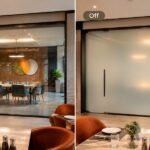
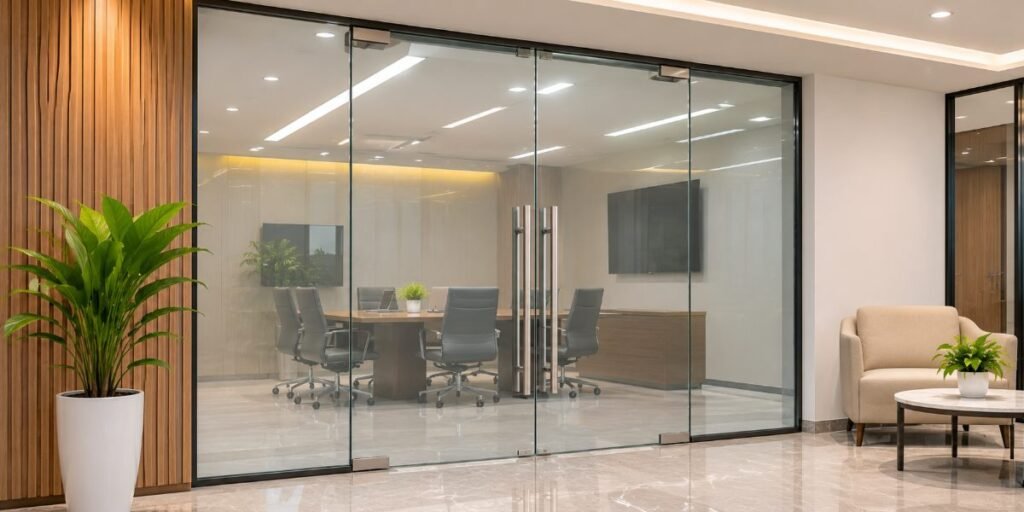
Walk into most modern offices and you’ll spot the compromise straight away. Someone specified a frameless glass door for the MD’s cabin, then stuck a manual roller blind on the inside, and now the blind hangs crooked and gets yanked twice a day. Smart glass doors remove that compromise. The leaf stays glass, the privacy arrives electrically, and there’s nothing dangling off the hardware. Glasstronn offers smart glass solutions that bring flexible privacy to modern office doors.
The idea is straightforward: a liquid crystal layer inside or on the glass turns milky when it loses voltage and clears when it gets it. The engineering behind a door, though, is genuinely harder than behind a fixed partition, because the leaf moves and the electricity has to move with it. Glasstronn focuses on practical smart glass solutions designed around these installation requirements.
Why Smart Glass Doors Are a Different Problem to Partitions
A partition is static. Run a cable into the frame once, tie it to a driver above the ceiling, and you’re finished. A door swings or slides hundreds of times a day, and every cycle flexes the conductor feeding the panel. Cheap installations of smart glass doors fail at exactly that point: not in the film, but where the cable enters a moving leaf. Fabricators solve it in three broad ways, and the choice affects your hardware schedule, your ceiling detail and your budget. Settle it at design stage, not after the frames are ordered.
How Switchable Glass Doors Work
From clear to private
The active element in smart glass doors is a polymer dispersed liquid crystal layer sitting between two conductive coatings. Unpowered, the crystals scatter light and the panel reads as translucent white. Apply low-voltage AC, usually 48V to 65V from a dedicated driver, and the crystals align so the panel clears in a fraction of a second. Power draw is modest, a few watts per square metre while clear, and nothing while private.
Be honest about the private state: it blocks sightlines, not light and not sound. A silhouette still reads against strong backlighting, and acoustic performance comes from the glass build and the door seals, never from the film.
Laminated units versus retrofit film
• Laminated PDLC glass doors: film sealed between two glass sheets during lamination. Edges are protected, the finish is clean, and this is the right answer for new-build work. Lead times run to several weeks and nothing can be resized later.
• Retrofit film on existing doors: applied to the inner face of glass already hung. Faster, cheaper, and useful in an occupied office. Edges are silicone-sealed, so it suits dry interiors rather than washroom doors.
Getting Power Into a Moving Door Leaf
Hinged and pivot doors
For a hinged leaf, the usual route is a concealed cable through the top patch fitting or floor spring, with a service loop long enough to absorb the swing without tension. Some fabricators use a hollow pivot pin. Either way the cable needs strain relief at both ends and slack that doesn’t rub the frame. Ask how many open-close cycles the connection has been tested to before signing off on hinged smart glass doors.
Sliding and telescopic doors
Sliding leaves are easier in one sense and harder in another. A coiled cable in the top track handles travel comfortably, but the track box gets deeper, which matters if you’re chasing a slim ceiling detail. On telescopic sets, only the leading leaf usually gets film.
Where movement is genuinely awkward, consider a fourth option: leave the leaf as plain glass and put the switchable film in the fixed side panels and fanlight around it. You lose privacy on a narrow strip and save a lot of complication.
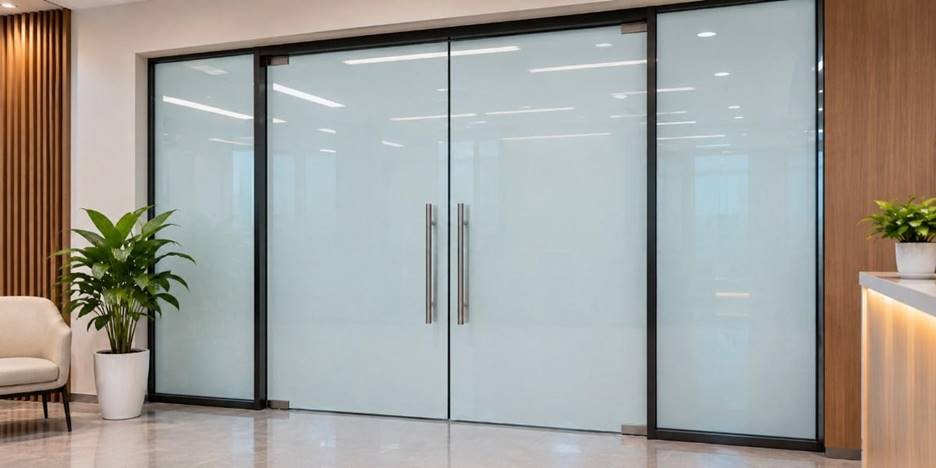
Hardware, Framing and Fabrication Details
Busbars along one edge of the panel must be concealed by the frame, beading or patch fitting, so the fabricator needs to know which edge carries them before cutting. On frameless smart glass doors this often forces a slim top rail where the design intent was pure glass, and it’s better to know that early than to argue about it on site.
Weight is the other quiet issue. A laminated switchable leaf is heavier than a single toughened pane of the same size, sometimes by a third, so floor springs, hinges and fixings should be sized for the finished unit. Leaves up to roughly 1000mm by 2400mm are routine; go wider and you’re into seamed film, and the seam shows when the panel is private.
Where Privacy Glass Doors Make the Most Sense
Some applications repay the cost quickly, others really don’t. The pattern is simple: privacy glass doors earn their place where the same opening must feel open at some hours and shut at others.
1. MD cabins and HR rooms, where a closed door shouldn’t feel like a bunker
2. Meeting rooms that host confidential reviews a few hours a week
3. Consulting chambers and diagnostic rooms in clinics, where curtains are a cleaning burden
4. Hotel bathrooms opening into the bedroom of a suite
5. Retail fitting rooms and jewellery viewing rooms
6. Home offices, en-suites and internal doors in premium apartments
Hotels and clinics usually order glass privacy doors in batches, which brings the per-unit rate down. For a door that stays shut all day, or a storeroom nobody looks into, plain frosted glass serves just as well for a fraction of the outlay. Being selective about which openings get smart glass doors is what keeps a project’s numbers sensible.
Comparing the Alternatives Honestly
| Option | Privacy control | Maintenance | Look | Indicative relative cost |
| Smart glass doors | Instant, switchable | Very low, no moving parts | Cleanest, frameless friendly | Highest |
| Blinds on glass doors | Manual, slow | Cords, dust, repairs | Cluttered on a swing leaf | Low |
| Frosted or etched glass | Permanent only | None | Clean but always closed | Lowest |
| Smart door glass with dimming driver | Adjustable haze | Very low | Clean, more nuance | Highest |
What Smart Glass Doors Cost in India
Treat any number as indicative, because glass build, hardware and control complexity move the total more than the film does. Retrofit film on an existing door usually falls around ₹700 to ₹1,400 per sq ft including application. Laminated PDLC glass doors generally start near ₹1,600 per sq ft and can pass ₹3,000 once you specify toughened laminated build-ups, larger sizes or special interlayers.
Then add the parts people forget: a driver per zone, the switch or sensor, cable routing through the hardware, and a two-person glazing crew for a heavy leaf. A single door always looks expensive per square foot because setup and travel are fixed costs. Six doors in one visit is a different rate entirely.
Frequently Asked Questions
Do smart glass doors go clear or private when the power fails?
They go private. With no voltage the liquid crystals scatter light, so the panel defaults to its translucent state during any outage. That’s usually welcome in a cabin or clinic, but awkward for a reception or showroom entrance, so those are often placed on a backed-up circuit.
Can existing glass doors be converted with switchable film?
Often, yes. Retrofit film goes onto the interior face of the existing leaf, and the constraints are cable routing through the hinge or track plus access to a power point. Converting to glass privacy doors this way avoids replacing hardware, though laminated units last longer. Many offices upgrade cabin doors during a weekend shutdown.
How long does the film last on a door that’s used constantly?
The film is not the wear item; the electrical connection at the moving edge is. Well-detailed smart glass doors, with a proper service loop and strain relief, typically give many years of daily use. Ask what the warranty covers on the film, the driver and the connection separately.
Are switchable glass doors soundproof when private?
No. Privacy and acoustics are unrelated here. Sound reduction comes from glass thickness, laminate interlayers, jamb and floor seals, and how the leaf closes. If confidentiality matters in a meeting room, specify an acoustic laminated build with proper seals alongside the switchable layer of smart door glass.
Conclusion
Smart glass doors solve a real design problem rather than an invented one. They keep the light and openness that made the client want glass in the first place, and they get rid of blinds that never look right on a swinging leaf. The technology itself is settled. What separates a good installation from a troublesome one is detailing: how power reaches the moving leaf, which edge carries the busbar, and whether the hardware is sized for the finished weight. Decide those while the drawings are still open. Glasstronn offers smart glass solutions designed around these practical installation requirements.
If you’re comparing options for a specific opening, an early conversation with an experienced smart glass fabricator usually saves more than it costs. Glasstronn will help you explore suitable options for your specific opening.
Ready to Upgrade Your Space with Smart Glass Doors?
Bring modern aesthetics and on-demand privacy to your interiors with smart glass doors. From executive cabins and conference rooms to commercial spaces, explore door solutions that maintain transparency while providing privacy whenever needed. Talk to a Smart Glass Doors Expert .
Follow Glasstronn on Instagram for smart glass projects, switchable film applications, technology updates and practical insights into intelligent privacy solutions.