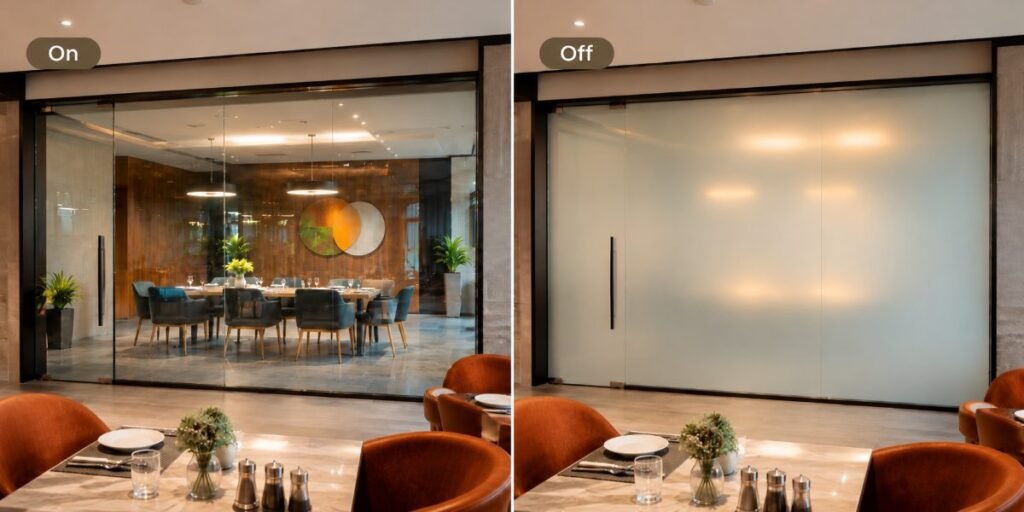
The glass is already installed. The partitions went up two years ago, the office is occupied, and the client now wants the two corner cabins to be private on demand. Taking those panels out means a weekend of noise, dust and disruption that nobody has budgeted for. PDLC film for privacy exists for precisely this situation, applied to glass that’s already in place and switching from clear to opaque in under a second. Glasstronn offers switchable film solutions for existing glass installations that need flexible privacy.
It’s the same liquid crystal technology used in laminated switchable panels, delivered a different way. That difference matters more than most product pages admit, and it cuts both ways. Glasstronn will help you explore suitable PDLC film options for your existing glass panels.
What PDLC Film for Privacy Actually Is
The layer stack
A sheet of smart film is thinner than it sounds, typically well under a millimetre. Inside it, droplets of liquid crystal sit dispersed in a polymer matrix, sandwiched between two transparent conductive layers and protected by outer PET carriers. A thin adhesive layer on one face bonds it to glass. Two busbars, one along each of two edges, carry the current in.
The switch
Apply low-voltage AC and the crystals swing into alignment with the electric field. Light passes through in a straight line and the film reads as clear. Kill the power and they relax into random orientation, scattering incoming light in every direction, and the film turns a milky translucent white. The transition is effectively instant, which is why demonstrations of switchable film always get the same reaction in a showroom.
Retrofit Film or Laminated Glass?
Both routes use the same core technology. The difference is where the film lives.
| Retrofit PDLC privacy film | Laminated switchable glass | |
| Applied to | Existing installed glazing | New panels, at the factory |
| Site disruption | Minimal, work happens in place | Panels removed and replaced |
| Film position | Surface-applied, inner face | Sealed between glass plies |
| Vulnerability | Cleaning chemicals, knocks, edge lift | Well protected |
| Replacement | Film only, glass stays | Whole panel |
| Typical cost pattern | Lower supply, higher skilled labour | Higher supply, factory labour |
For occupied premises, film is often the only workable answer. For a new fit-out where glass is being ordered anyway, laminated panels are usually the better long-term buy. PDLC film for privacy makes most sense when the glass is staying put.
How Smart Privacy Film Is Installed
Surface preparation
Applying PDLC film for privacy is a wet process, closer to high-end automotive tinting than to sticking up a vinyl graphic. The glass is cleaned exhaustively, a slip solution goes down, the film is positioned, and the solution is squeegeed out from the centre. Any grit left on the glass shows up permanently as a visible bump.
The room needs to be reasonably clean and still. Application in an active site with grinding and drilling going on nearby is asking for contamination, which is why this work should be scheduled after the wet and dusty trades have finished.
What goes wrong
• Trapped moisture, which can take days to clear and sometimes never does fully
• Dust inclusions, visible as small raised points under raking light
• Edge lift, usually from a busbar detail that wasn’t sealed or concealed properly
• Cable routing left as an afterthought, resulting in visible trunking on a feature wall
• Cutting tolerance, since the film should stop just short of the glass edge rather than run to it
None of these are exotic problems. They are workmanship problems, which means the installer matters as much as the film brand.
What PDLC Film for Privacy Can’t Do
Set expectations honestly and clients stay happy. Standard grades go translucent white, not dark, so the film gives you visual privacy while still passing daylight. Silhouettes disappear; brightness doesn’t. If a client wants a genuinely dark room, that needs a dye-doped blackout grade, which is a different product at a different rate.
It also won’t fix solar heat gain, and it won’t give you acoustic separation. A privacy window film with a solar control layer is a separate specification, and speech privacy is a question about frames, floors and ceiling voids rather than glass. If glare on a west elevation is the real complaint, a solar-control privacy window film or an external shade will do more for the room than switching ever will. Curved glass, heavily textured surfaces and panels with existing scratches or old adhesive residue are all poor candidates.
Power, Drivers and Switching for Switchable Film
PDLC film for privacy runs on low-voltage AC, generally somewhere in the 48V to 65V band, produced by a driver that converts your 230V supply. One driver covers a defined maximum area, so a long run of glazing needs several. Give each one a ventilated, accessible position, because a driver buried in a sealed ceiling pocket becomes a demolition job the day it fails.
Switching options span wall rockers, touch panels, remotes, occupancy sensors, door contacts and BMS integration through a dry-contact input. That last option has to be specified when you order the driver. Power draw while clear sits at a few watts per square metre, and drops to nothing when the film is off, so running cost is not a meaningful line item.
Cost, Lifespan and Warranty
All figures are indicative and depend on grade, area and site conditions. Supply rates for retrofit PDLC film for privacy in India typically run below equivalent laminated panels, often in the region of ₹1,200 to ₹2,500 per square foot, with application labour, drivers, cabling and switches on top. Small jobs carry a higher effective rate because mobilisation cost gets spread over less area.
Service life depends mostly on three things: UV exposure, moisture at the busbars, and voltage stability. PDLC privacy film on an internal partition, cleaned sensibly and fed clean power, lasts considerably longer than the same film on a west-facing window with no protection. Ask what the warranty covers, whether the driver is included, and what the process is if one panel starts flickering after three years.
Caring for Smart Film Day to Day
Treat the surface as delicate rather than fragile. Use a mild solution and a soft microfibre cloth, keep ammonia-based cleaners and abrasive pads well away, and don’t let liquid pool at the edges where the busbars sit. Brief the housekeeping team once at handover, in writing, because a single enthusiastic cleaning routine with the wrong chemical can damage an edge that will then need the whole sheet replaced.
Avoid taping notices or hooks to the film, and keep furniture from resting against it. Small habits decide how good it looks in year five.
Frequently Asked Questions
Is PDLC film for privacy as good as laminated switchable glass?
Optically it comes very close, and most people cannot tell the two apart across a room. The real difference is durability. A laminated panel seals the film between glass, protecting it for the life of the unit, while surface-applied film stays exposed to cleaning, knocks and edge damage.
How long does installation take?
For a typical office cabin with two or three panels, applying PDLC film for privacy is a day’s work, plus electrical routing and driver installation. The unpredictable part is drying, since trapped moisture in the adhesive can take several days to clear completely. Plan for a slightly hazy appearance in the first week.
Can the film be removed later?
Yes. Smart privacy film can be peeled off and the glass cleaned back, though adhesive residue takes patience and the right solvent. That reversibility is one of the genuine advantages of the retrofit route, especially in leased premises where you may need to hand the space back in its original condition.
Does it work on toughened glass?
It does, and most partitions it goes onto are toughened. What matters more is surface flatness and cleanliness. Heavily textured, patterned or curved glass makes proper adhesion difficult, and any existing scratch or residue under the film becomes permanent once the sheet is down.
Conclusion
PDLC film for privacy solves a specific problem well: you have glass, you want it to switch, and you can’t take the partitions out. The technology inside is the same one used in laminated switchable panels, so the optical result is close, and the trade-off you accept is exposure rather than performance. Glasstronn offers switchable film solutions for existing glass installations that require on-demand privacy.
Judge the installer as carefully as the product, keep the drivers accessible, brief the cleaning team, and expect translucent white rather than darkness unless you’ve specified a blackout grade. If you’re weighing up film against replacing the glass entirely, talking it through with an experienced supplier is the fastest way to get answers matched to your site. Glasstronn will help you explore suitable options for your existing glass.
Need PDLC Film for Privacy in Your Existing Glass?
Upgrade your existing glass partitions without replacing the entire installation. PDLC film for privacy offers a practical way to switch between clear visibility and frosted privacy. Explore installation options for office cabins, meeting rooms and residential spaces.Talk to a PDLC Film Expert .
Follow Glasstronn on Instagram for smart glass projects, switchable film applications, technology updates and practical insights into intelligent privacy solutions.