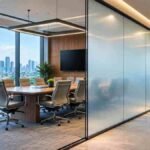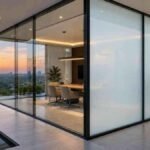

You flick a switch and the glass in front of you stops behaving like glass. Not frosted, not milky, but properly dark the way a closed door is dark. That is what blackout switchable film does, and it explains why boardrooms, consultation rooms and premium bedrooms keep asking for it after ordinary privacy film disappoints them in strong afternoon light. Glasstronn provides smart privacy solutions for projects where controlled visibility and blackout performance are important. Glasstronn can help project teams evaluate the right switchable solution based on the required privacy and application.
The material is usually sold as DDLC film, and it behaves quite differently from the PDLC products most people have already seen in office cabins. Understanding that single difference decides whether you get genuine darkness or an expensive glow.

What Blackout Switchable Film Actually Is
Strip a sheet of blackout smart film down and you have a sandwich about 0.4 mm thick. Two outer sheets of PET carry a transparent conductive coating on their inner faces. Between them sits a liquid crystal layer mixed with a dichroic dye. An optically clear adhesive on one side lets the whole thing bond to glass, and two thin bus bars run out to a driver.
With no voltage applied, the liquid crystals scatter in random directions and the dye absorbs light rather than merely diffusing it. The panel switches to a dark opaque state, significantly reducing transmitted light. The exact appearance depends on the product grade, glass configuration and surrounding installation details. Apply mains-derived AC through the driver and the crystals align, the dye molecules line up with them, and the film clears to a tinted transparency. Power off means dark. Power on means clear. That default state matters more than people expect, because a power cut leaves the room private rather than exposed.
How DDLC Film Differs From Standard PDLC
The most smart film on the market is PDLC: polymer dispersed liquid crystal. It switches between clear and white translucent. It hides shapes but it does not stop light, and in a west-facing meeting room at 4 pm you can still make out silhouettes moving behind it. Static privacy film, the etched-look vinyl kind, costs less again but only ever gives you one state.
The frosted-state limitation
Translucent white works well when you want daylight plus visual separation. It fails when the brief says darkness. Cinema rooms, sleep environments, hospital observation windows and any space where a projector needs contrast will all expose the weakness of a frosted state.
What the dye layer changes
DDLC film adds absorption to the scattering. Because the dye soaks up transmitted light instead of bouncing it around, the off state reads as charcoal or near-black depending on the grade. You still get some light bleed at the edges and through any gap in the frame, which is why installers treat the perimeter detail as part of the specification rather than an afterthought.
Where Blackout Smart Film Makes Sense
Blackout switchable film suits a narrower set of jobs than standard smart film, but it owns those jobs outright:
• Bedrooms and villa glazing where guests want darkness without motorised blinds hanging in the sightline
• Home theatres and demo rooms where ambient light kills contrast
• Hospital and diagnostic rooms needing instant, wipe-clean privacy with no fabric to launder
• Executive cabins and legal chambers where confidentiality matters more than borrowed daylight
• Retail display cases and vault windows that stay dark until a customer is in front of them
If your requirement is simply “people should not see it during a meeting”, ordinary PDLC will do the same job for less money.
Power, Drivers and Control
Every blackout switchable film installation needs a driver, sometimes called a transformer or controller, converting your supply into the AC waveform the film wants. Typical operating voltage sits in the 48–65 V AC range depending on the manufacturer, and power draw is modest: roughly 4–7 watts per square metre while clear, essentially nothing while dark.
Switching options
• Rocker or touch switch on the wall, simplest and most reliable
• Remote or RF control, useful for large glazed partitions with no convenient wall
• Building management system integration through a dry contact or relay module
• App and voice control via a smart relay, though you should keep a physical override
Cable runs matter. Long runs from driver to film can cause voltage drop and uneven switching, so plan a driver location within a few metres of the panel and leave an accessible service point. Concealing a driver permanently behind sealed gypsum is a repair bill waiting to happen.
Blackout Switchable Film Specs Worth Checking Before You Order
| Parameter | Typical Range | Why It Matters |
| Visible Light Transmission (Clear) | 45–70% | Determines how much natural light passes through when the film is switched clear. |
| Transmission (Opaque) | 3–15% | Indicates the amount of light passing through when the film is switched to its opaque privacy state. |
| Operating Voltage | 48–65 V AC | Must be compatible with the supplied driver for safe and reliable operation. |
| Switching Speed | Under 1 second | Enables quick transition between clear and opaque states. |
| Maximum Roll Width | 1.2–1.5 m | Helps determine whether larger glass areas require seams or butt joints. |
| Warranty | 1–2 years | Check whether the warranty covers the film, electrical components, installation, or specific defects. |
UV Protection: Ask for the UV-cut specification when comparing products. UV protection can help reduce UV exposure through the glazing, but it should not be considered a replacement for low-E or other high-performance glazing.
Laminated Glass or Retrofit Application?
Two routes exist. Laminating blackout switchable film between two glass panes at the factory gives you a sealed unit, cleaner edges, better longevity and no exposure to site dust or humidity. Retrofit means applying self-adhesive film to existing glass in place, which suits refurbishments where replacing the glazing is impractical.
Retrofit is cheaper and faster, but it is unforgiving. Dust under the film shows permanently, edges remain visible, and Indian coastal humidity can attack an exposed edge over time unless it is sealed properly. For new projects with any budget flexibility, laminated is the better long-term call. For a leased office fit-out with a five-year horizon, retrofit is perfectly sensible.
Indicative Cost and What Tends to Go Wrong
Pricing depends on grade, size, and whether you are buying film alone or finished laminated glass. As an indicative range, retrofit blackout switchable film commonly lands somewhere around ₹6,000–₹8,000 per square foot supplied, with laminated switchable glass units running higher once toughening and fabrication are included. Drivers, switches and installation labour sit on top. Treat any figure quoted without a drawing as a rough guide only.
Blackout switchable film has a handful of recurring failure modes worth knowing about. Edge delamination on retrofit jobs, usually from poor sealing. Uneven switching caused by a driver mismatched to panel area. a client who expected total darkness and got a thin halo of light around the frame, because nobody detailed the perimeter.
Why Choose Glasstronn for Blackout Switchable Film?
Choosing the right blackout switchable film is about more than selecting a product. Panel size, glass compatibility, installation method, driver requirements, edge detailing and the intended level of privacy all affect the final performance. Glasstronn helps customers evaluate these factors and identify a switchable glass solution suited to their specific application. From understanding whether retrofit film or laminated construction is appropriate to planning control options and installation requirements, Glasstronn focuses on practical project considerations rather than a one-size-fits-all approach.
For residential, commercial and privacy-focused spaces, getting the specification right before installation can help avoid issues such as uneven switching, exposed edges and unsuitable glass configurations. With guidance from Glasstronn, project teams can discuss their requirements, understand the available options and plan their blackout switchable film installation with greater confidence.
Frequently Asked Questions
Does blackout switchable film block 100% of light?
Close, but not absolutely. Good blackout grades can have opaque-state transmission in the 3–15% range, depending on the product specification. The actual level of darkness also depends on the glass configuration and perimeter detailing.
Can blackout switchable film be cut on site?
It can be trimmed, but only by a trained installer who knows how to re-establish the bus bar connection and seal the cut edge. A careless cut severs the conductive path and kills the panel. Most suppliers prefer to cut to size in controlled conditions and deliver pre-terminated sheets.
How long does DDLC film last?
Expect laminated blackout switchable film to give ten years or more when it is kept out of constant harsh sun, and somewhat less for retrofit applications in exposed conditions. Performance degrades gradually rather than failing outright: switching slows, and the clear state loses a little of its clarity.
Is it suitable for curved or shaped glass?
Gentle curves are possible with laminated construction and careful fabrication. Tight radii, compound curves and sharp corners are not. Shaped cutouts around handles or hinges are usually fine if planned before manufacture. Send your fabricator the actual template early rather than a nominal dimension.
Conclusion
Blackout switchable film is a specialist product, not a general upgrade. Where the brief genuinely calls for darkness on demand, it does something no fabric blind does as cleanly: it disappears into the glass and leaves the architecture alone. Where the brief only calls for visual privacy, standard PDLC film will serve you better per rupee spent. Make that call first, then work through voltage, driver placement, edge detailing and whether laminated or retrofit fits your programme. Get those four decisions right at the design stage, rather than discovering them on site, and the product behaves predictably for years.
If you are weighing up your options, walking a supplier through your drawings and site conditions is the fastest way to get answers matched to your project rather than generic specifications. Glasstronn can help you evaluate the appropriate blackout switchable solution based on your application, glass configuration and privacy requirements. Glasstronn also provides expert guidance for planning a smart glass solution that fits your project requirements.
Ready to Discuss Your Blackout Switchable Film Project?
Whether you’re planning a new installation or evaluating a retrofit, speak with our team to discuss your glass dimensions, application, privacy requirements and installation conditions. Talk to an Expert
Follow Glasstronn on Instagram for smart glass projects, applications, product insights and the latest updates in intelligent privacy solutions.