Anyone who has stayed in a hotel and woken at 5.30 am to a bright stripe down the middle of the room knows the problem with blackout curtains. They work until they don’t, and the failure is always at the edges. Comparing blackout switchable film vs curtains starts there, with a question about how dark you actually need a room to be and how much fuss you’re willing to tolerate to get it. Glasstronn provides smart glass solutions for spaces where privacy, darkness and clean architectural design matter. Glasstronn helps project teams assess switchable solutions according to their specific requirements.
What Each Option Actually Does
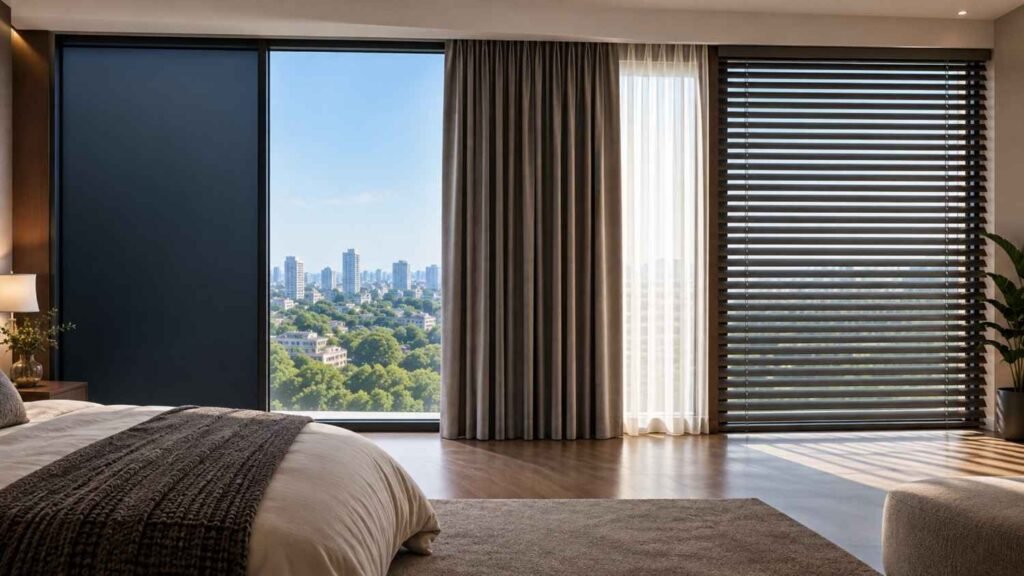
Curtains and blinds are physical barriers hung in front of glass. They block light by covering it, they need clearance to stack or roll, and they collect dust while doing it. Blackout linings and side channels improve them, at the cost of bulk and money.
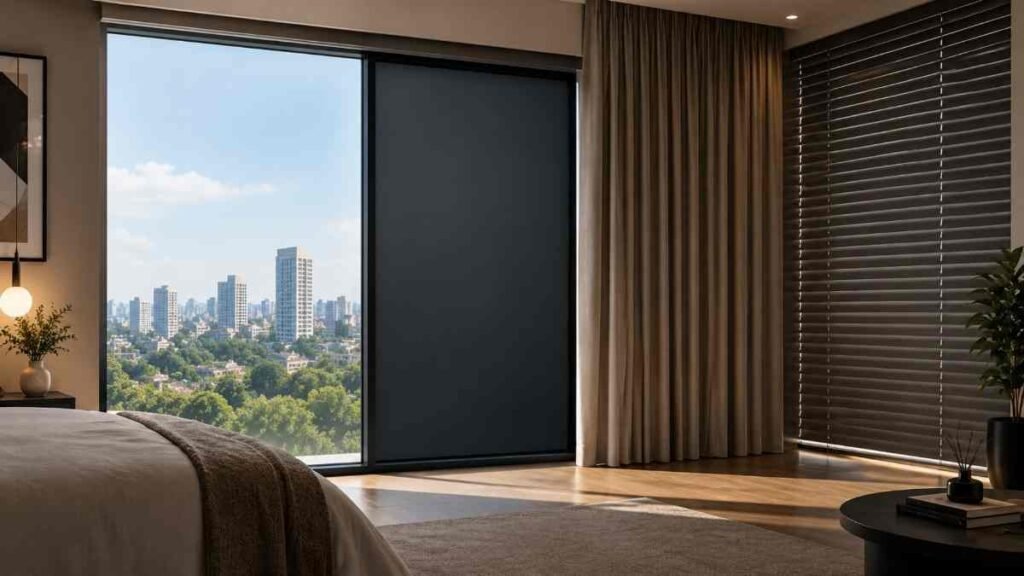
Blackout switchable film is a liquid crystal layer either laminated inside the glass or applied to it as a retrofit smart window film. Off, the panel is dark and near-opaque. On, it clears to a lightly tinted transparency in under a second. Nothing hangs in front of the window, and nothing moves.
There is also the middle ground people forget: standard PDLC smart film, which switches clear to translucent white, and static privacy film, which is permanently frosted and cannot switch at all.
Blackout Switchable Film vs Curtains on Darkness
Fabric blocks light well in the middle and badly at the perimeter. Even with a pelmet and side channels, most installations leak somewhere. Switchable panels can have opaque-state transmission in the 3–15% range, depending on the product specification, so the glass itself can appear very dark
Space, Sightlines and How the Room Reads
This is where switchable panels pull ahead decisively. A curtain stack eats 150 to 300 mm of wall on each side of a window, and blinds occupy the head detail. In a compact apartment or a hotel room with a tight furniture layout, that is real floor area.
Nothing projects from a switchable panel. The glazing line stays clean, sills stay usable, and there is no fabric colour to coordinate or replace when the interior scheme changes. For minimal interiors, frameless partitions and anywhere the architecture is the point, this matters more than any performance number. On sightlines alone, blackout switchable film vs curtains is not a close call.
Cost Over a Decade: Blackout Switchable Film vs Curtains
| Factor | Curtains and blinds | Blackout switchable film |
| Indicative supply and fit | Roughly ₹200–₹1,200 per sq ft of window | Roughly ₹6,000–₹8,000 per sq ft retrofit, more laminated |
| Electrical work | None, unless motorised | Driver, wiring, switch or BMS point |
| Cleaning and upkeep | Regular washing or dry cleaning | Wipe down, no consumables |
| Replacement cycle | Fabric typically 5–8 years in daily use | Around ten years or more |
| Failure modes | Torn fabric, jammed tracks, sun-faded lining | Driver failure, edge issues on retrofit |
| Space taken | 150–300 mm stack each side | None |
Read that honestly and curtains remain much cheaper up front. The gap narrows over a decade once you count refabrication, dry cleaning and track repairs, but it rarely closes entirely. Choose switchable panels for what they do, not for a payback calculation.
Smart Film vs Blinds on Daily Operation
Operation is the underrated difference. A blind needs someone to reach it. In a double-height living room or above a fixed sofa, that means motorising it, which introduces its own motors, remotes and eventual repairs. A switchable panel is a wall switch, a scene on a control panel, or a BMS command.
• Speed: under a second to switch, versus several seconds for a motorised blind
• Noise: silent, versus the audible whirr of a motor in a quiet bedroom
• Reach: no access needed at the window at all
• Failure: a driver swap, versus a motor or track replacement
• Integration: a dry contact connects easily to most automation systems
Dust, allergens and Indian conditions
Fabric in Indian cities is a maintenance commitment. Delhi and Bengaluru dust settles into pleats and linings, monsoon humidity encourages mildew on window-side fabric in coastal homes, and heavy blackout linings are awkward to launder. On upkeep, smart film vs blinds is not a close contest: glass wipes clean in seconds and holds nothing.
Weigh smart film vs curtains in a clinic or a food environment and the hygiene argument gets stronger still, since there is no textile surface to harbour anything.
Where Curtains and Blinds Still Win
There are plenty of them, and an honest reading of blackout switchable film vs curtains has to name them:
1. Budget-led projects. Nothing beats fabric on cost per square foot.
2. Rented spaces. Curtains move with you. Film does not.
3. Windows without a power route. Running a supply to an isolated opening can cost more than the smart window film itself.
4. Acoustic softening. Heavy drapes absorb sound and reduce echo in hard-surfaced rooms; glass does the opposite.
5. Warmth and texture. Some interiors need fabric. A dark glass panel is architectural, not cosy.
6. Thermal buffering. A lined curtain across a single-glazed window cuts winter heat loss more than film does.
Choosing for Hotels, Homes and Clinics
Hotels tend to split the difference on blackout switchable film vs curtains. Sheer curtains for softness and daytime diffusion, switchable panels or blackout blinds for the actual darkness. Guests understand a wall switch immediately, which matters more than designers assume.
Homes usually come down to the bedroom. If someone in the house sleeps during the day, or a home theatre is involved, switchable glazing is worth the cost. Living rooms and studies rarely justify it. A retrofit privacy film on a bathroom window costs a fraction and solves that particular brief entirely.
Clinics and consultation rooms are the clearest case. Instant privacy, wipe-clean surfaces, no fabric to launder, and a default-dark state during a power cut that keeps patients covered.
Why Choose Glasstronn for Blackout Switchable Film?
Choosing between blackout switchable film, curtains and blinds depends on more than the initial cost. Factors such as the required level of darkness, available space, maintenance, electrical access, installation conditions and how the room will be used all need to be considered. Glasstronn helps customers evaluate these practical factors and understand which privacy and blackout solution is most appropriate for their space.
Whether the priority is a clean architectural appearance, on-demand privacy, reduced maintenance or flexible control, Glasstronn can help project teams compare the available options before making a decision. From existing glazing and retrofit requirements to driver placement, control systems and room-specific needs, the focus is on finding a solution that fits the actual project rather than recommending switchable film for every situation.
Frequently Asked Questions
Is blackout switchable film vs curtains a fair comparison on price?
Not on the initial quote. Fabric is far cheaper to buy and fit. The comparison becomes fairer over ten years once cleaning, refabrication and track repairs are counted, and fairer still if you value the floor space and sightlines that curtains consume. Even then, film usually costs more overall.
Can I use both together?
Yes, and many projects do. Treating smart film vs curtains as a strict either/or is usually a mistake. A sheer curtain softens the room and diffuses daylight while switchable glazing handles privacy and darkness on demand. This works particularly well in hotel rooms and master bedrooms where the interior scheme needs some textile presence.
Does switchable film keep heat out like a blackout blind?
Partly. It blocks most UV and trims some solar gain in its dark state, but it sits in the glass rather than insulating the opening. A lined blind adds an air gap and performs better thermally on single glazing. Proper low-E glazing outperforms both.
What happens during a power cut?
The panel goes dark, since the film is opaque without voltage. That’s helpful for privacy and unhelpful if you wanted daylight. In areas with frequent outages and no inverter backup, mention this to the client early rather than letting them discover it.
Conclusion
The blackout switchable film vs curtains question is really about what a room is for. Bedrooms that need genuine darkness, clinics that need instant privacy, and tight interiors where a curtain stack costs real floor area all point one way. Budget projects, rented flats, windows with no power route and rooms that need fabric warmth point to the other. Neither answer is wrong, and specifying an expensive switchable panel where a good blackout blind would have done is a common and avoidable mistake. Decide what the room needs first, then price the options.
If you are weighing up your options, walking an experienced supplier through your drawings and site conditions is the fastest way to get answers matched to your project. Glasstronn can help you compare blackout switchable film with curtains and blinds based on darkness, space, maintenance, installation and your specific room requirements. Glasstronn can also guide you through the practical considerations before you choose a privacy and blackout solution.
Ready to Compare Your Blackout Options?
Tell us about your room, glazing and privacy requirements, and get practical guidance on whether blackout switchable film, curtains, blinds or a combination makes the most sense for your project.WhatsApp Our Team
Follow Glasstronn on Instagram for smart glass projects, switchable film applications, product insights and the latest developments in intelligent privacy solutions.